Students from Eindhoven University of Technology have developed ARIA, a modular electric car. Photo: Sarp Gürel.
The automotive industry is undergoing major change. As society transitions to more electric vehicles, new demands are being placed on charging infrastructure, product assortments adapted for EVs, and the right skills in workshops to ensure vehicle functionality. ARIA is a concrete example of how the car of the future can be designed with repairability in mind. Through a modular structure—where each component is independent and replaceable—the project challenges the view of the car as a closed system and instead puts the car owner’s access, freedom of choice, and control at the center.
“The transition to electrification is not only changing vehicles; it is changing the entire ecosystem around the car and placing new demands to ensure vehicle functionality in the society. At the same time, the myth that electric cars do not need service or repairs has been debunked—it is rather about a new type of service. ARIA is an example of how the forms are changing, while the need for service and repair remains,” says Pehr Oscarsson, President and CEO of MEKO.
When design determines who can repair
Through standardized and interchangeable components—from batteries to body panels—ARIA challenges today’s electric vehicle design, where integrated systems often make repairs both complex and costly. The ambition is to demonstrate that design choices play a decisive role in who can actually carry out service and repairs.
At the same time, the project aims to inspire automakers and EU decision-makers to include passenger cars in future Right to Repair legislation, thereby ensuring access to repair information, tools, and vehicle data for both consumers and independent workshops.
“Whether or not ARIA ever reaches the roads, it is a sign that both players in the automotive aftermarket and car owners are questioning today’s repair practices, which can limit the ability to make cost-effective decisions. Today, electric cars are not covered by the EU’s current directives, making affordable repairs more difficult for both consumers and independent workshops,” says Pehr Oscarson.
Growing momentum for Right to Repair
The issue of the right to repair is therefore not only about technology, but also about regulation, competition, and consumer power. Overall, there is clear momentum behind the Right to Repair movement. The EU has already taken important steps through new legislation that strengthens consumers’ right to repair products, and discussions about also including electric vehicles and vehicle data are intensifying. Even though the regulatory framework does not yet fully cover passenger cars, both political initiatives and increasing engagement from industry stakeholders indicate that the issue will become increasingly important in the coming years.
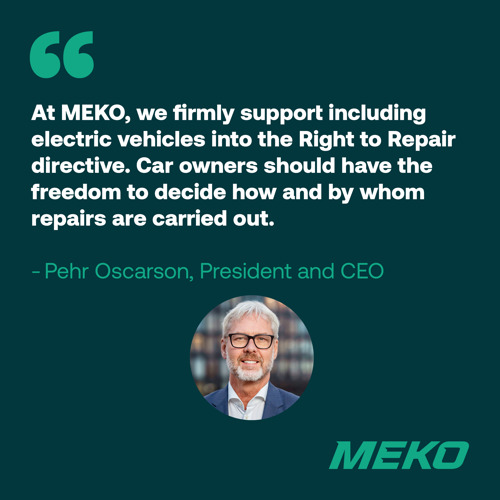
“At MEKO, we firmly support including electric vehicles in the Right to Repair directive. Car owners should have the freedom to decide for themselves how and by whom repairs are carried out. For decades, independent workshops have played an important role in the industry, ensuring competition and cost-effective repair solutions,” says Pehr Oscarson.
Explore the Right to Repair in our feature: Right to Repair: Avoiding pitfalls when going electric
About the EU’s Right to Repair directive:
The Right to Repair directive aims to make it easier and more affordable for consumers to repair electric vehicles and their electronic components by ensuring that spare parts, repair manuals, and software updates are made available to independent repairers and consumers for a certain period after purchase. The objective is to reduce electronic waste, promote sustainability, and extend the lifespan of products.




