Today, MEKO is the leading player in the independent aftermarket in Northern Europe. The core business is to deliver spare parts to customers such as workshops, wholesalers, and car owners through a dense distribution network across eight markets. Fast deliveries are critical, as they ensure that vehicles in need of repair can get back on the road without delay rather than remaining in the garage.
“Availability is number one for our customers, and our national distribution centers play a key role in our logistics system,” notes Jessica Tjulander.
At the heart of logistics
MEKO’s national distribution centers, often referred to as central warehouses, secure the right assortment for more than 700 regional and local warehouses across the group’s markets. Until now, MEKO has operated one automated central warehouse – in Strängnäs, Sweden – enabling fast and efficient handling of goods for both Sweden and Norway. Central warehouses in other markets have relied on manual handling.
But in 2025 MEKO has taken a major technological leap forward. Three automated national distribution centers have been completed in Denmark, Norway, and Finland – simultaneously.
“It has been an intense year, but now the buildings are ready, the technology is up and running, and operations are in place. This gives us entirely new opportunities to support our customers with a broader product range and at the same time with higher efficiency,” says Jessica Tjulander.
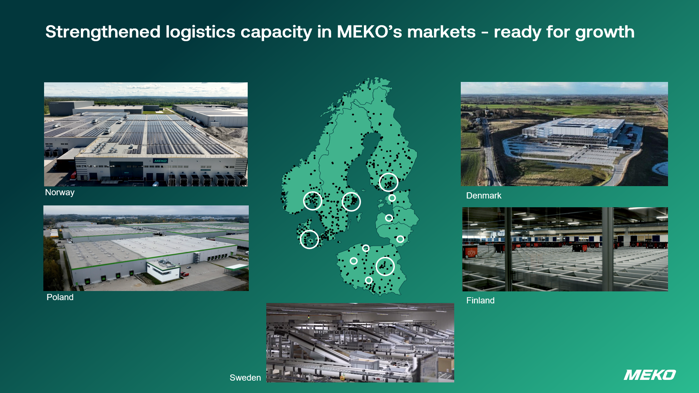
In Norway and Finland, MEKO uses technology from well-known Autostore. In Denmark, a shuttle system from KNAPP has been installed. Both systems are highly productive and come with different strengths.
Significantly higher productivity – larger capacity So what does MEKO’s upgrade mean in practice? A few facts:
- A quarter more space. The total area of MEKO’s upgraded warehouses increases by about 28 percent to just over 159,000 square meters. This corresponds to almost 22 football fields.
- Increased warehouse capacity. The upgraded facilities enable a 50 percent increase in stored items, making room for a broader assortment and new business opportunities.
- Nearly doubled productivity. The number of orders handled per working hour increases by 92 percent compared with the previous solution.
But the new warehouse solutions go beyond hard, technical facts. They also bring a better work environment with improved ergonomics for employees, a benefit that makes recruitment easier as well.
Above all, the new distribution centers are a key piece of MEKO’s growth strategy. In 2025, the group has announced new initiatives to increase sales of products under its own brands and to grow within the commercial vehicle segment.
“To deliver on our ambitions, we need the right warehouse space and stronger logistics capacity. We now have that in place. In short, this also enables us to strengthen MEKO’s position for the future,” says Jessica Tjulander.




