
Car buying gets political and the Nordic countries are the pickiest


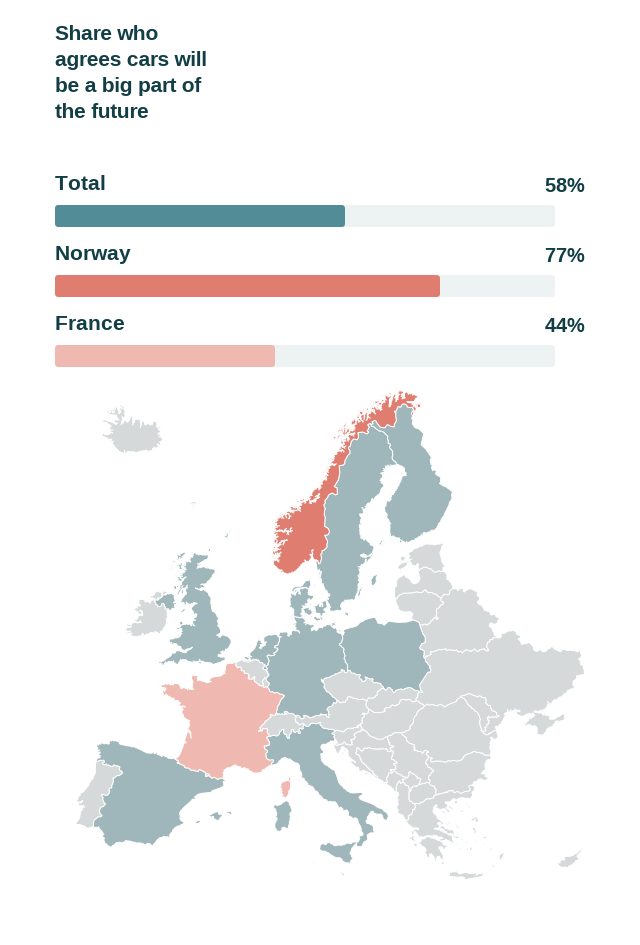
From Poland to the UK and Germany, a clear majority believes in the car’s future. Norwegians and Danes, who have come furthest with adopting EVs, are the most convinced. There’s more skepticism in the two countries where people drive the most.
More than a decade ago, researchers and trend analysts began talking about “peak car,” the hypothesis that car use in wealthy countries had peaked and would now begin to decline. New generations would instead choose bikes, trains and sharing services.
Europeans do not seem to have taken that message to heart yet. Nearly six in ten expect cars to play a major role in the future. Only one in ten disagrees. In ten of the 11 countries surveyed, a majority believes in the car’s future.
Belief strongest where EVs roll
Norwegians are the most convinced. Three in four believe in the car’s future, and half strongly agree. No other country comes close. Danes rank second.
It may not be a coincidence that these two countries lead. Nowhere in Europe has the shift to EVs come further. When you change what powers the car, it seems to take on new purpose. It becomes part of the solution – a greener way to drive, with lower emissions.
Doubt runs highest where people drive the most
At the other end of the scale is France, where 44 percent believe in the car’s future and three in ten have no firm opinion. Italians are also more hesitant than the average.
That may seem like a paradox, given that the French and Italians drive more than anyone else in Europe. Perhaps the answer lies in how they see the transition to electric. In France, many people view EVs as a choice for the wealthy, and range and charging are seen as big obstacles. When the path toward what is perceived as the car of the future feels uncertain, confidence in the future of the car may also wane.
Nobody knows what will be under the hood in the future
While Europeans largely agree that the car has a future, what will power it is less clear. One in four believes that gas and diesel cars will never fully disappear, and only just over one in ten think it will happen within ten years. Almost as many simply don’t know.
Germans are the most skeptical. In Europe’s largest car-owning nation, nearly one in three expects fossil-fuel cars to stick around forever. Even in Norway, which has the highest share of EVs in the world, three in ten think gas-powered cars will never vanish completely.
Meanwhile, faith in the car looks like it’s growing, not fading. In the Nordic region, where the Barometer has been tracking confidence since 2022, confidence has never been higher. The car may not have reached its peak yet – it might simply have been reincarnated.
How MEKO views the trend
While this year’s Mobility Barometer shows a positive outlook for the car, it also shows that the question of how tomorrow’s cars will be powered remains open.
There is every reason to believe that car fleets will become more complex than ever for a long time to come. Since many people keep their cars as long as they run, the car fleet is being replaced slowly. Gas and diesel cars will remain on the road for years, even as the number of EVs and HEVs increases. Hydrogen and other new technologies may play a larger role and solutions may emerge that nobody can foresee today.
Our mission is to work with all these technologies, so every car owner can get their car serviced and repaired, whatever it uses for fuel. That’s why we lead the way in skills development through the MEKO Academy, where mechanics across our markets are trained both in today’s and in tomorrow’s automotive technology.


