
Car buying gets political and the Nordic countries are the pickiest


Electrification is Europe’s most talked-about automotive trend. However, whether people can picture themselves owning an EV varies widely from country to country. Where EVs are already common, the answer is usually yes. Where charging stations seem too few and prices too high, more people say no.
EVs are often described as essential for combating climate change, the car of the future and proof that the transition is underway. Yet many people cannot imagine themselves behind the wheel of one.
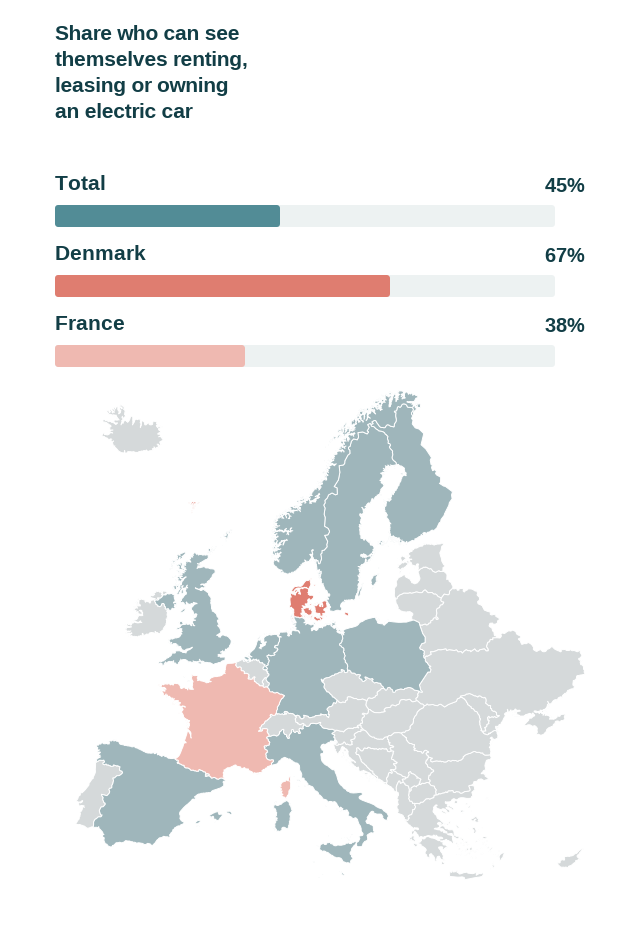
This year’s Mobility Barometer asked people in 11 European countries which kinds of cars they would consider renting, leasing or owning. Of those asked, 45 percent would consider an EV. Almost as many, four in ten, said no.
A car for someone else
The contradiction is sharpest in the UK. Nearly half agree that the green transition will not happen without EVs, more than in any other country. Yet it is the British who are the most likely to say that they cannot imagine owning one themselves.
Spain shows the same split. Belief in the environmental benefits of EVs is strong there, but more people say no than yes to driving one.
Neighbors make a difference
The picture is different in Denmark and Norway, where EVs are already common. In Norway, more than one in three people have access to one, and two in three Danes and six in ten Norwegians would consider owning one. This would indicate that experience seems to matter. Once an EV is parked in the neighbor’s driveway, it stops being a concept. It becomes ordinary.
Luxury car or affordable car?
Money is often behind the hesitation. Europeans are split on whether EVs are “only for the rich”. One in three agrees, and one in three disagrees. France leans furthest toward yes, with nearly half agreeing. It is also where the smallest share of people can imagine owning an EV. In Norway and Denmark, only one in five shares that view.
Those who say no keep giving the same three reasons: that they can’t afford one, that there are too few charging stations where they live and that the range isn’t enough. For the French, range is the most important reason. More than half of French opponents say EVs cannot handle their trips.
When asked what would make them more likely to choose an EV, the answer is the same in all 11 countries: cheaper cars.
Nordic countries change course
In the Nordic region, skepticism toward EVs has grown each year from the Barometer’s launch in 2022. This year, that trend changed course, especially in Denmark and Finland. Sweden is going the other way. The share of Swedes who cannot imagine owning an EV remains well above where it was four years ago.
EVs are spreading across Europe, and with them comes a need that’s easy to miss: they need maintenance and repairs too. Norway, where EVs have been on the road the longest, shows why. A 2026 report from the Norwegian Public Roads Administration found wear-and-tear defects in 30 percent of ten-year-old EVs. For gas and diesel cars, the figure was 16 percent.
The Administration points to two things. EVs are heavier, so they wear faster, and some owners skip services because there is no oil change due. The lesson for the rest of Europe is simple: an EV that is serviced regularly is safer and lasts longer. EVs come through MEKO’s workshops every day. We want owners to see maintenance as just as natural a part of EV ownership as it is for other types of cars.
Source: Norwegian Public Roads Administration, January 2026


